Laos - from Thai border to Vientiane
|
|
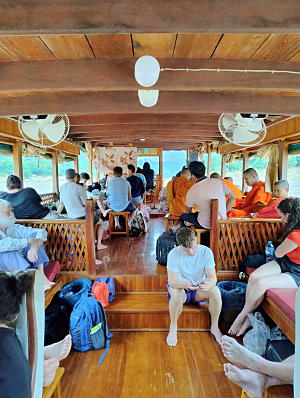 We enjoyed the trip; the
seats are comfortable enough, and we were near the front of boat, where
it it quieter, away from the motor. The river runs brown and swift, with
rocky outcrops and rapids along the way.
We enjoyed the trip; the
seats are comfortable enough, and we were near the front of boat, where
it it quieter, away from the motor. The river runs brown and swift, with
rocky outcrops and rapids along the way.
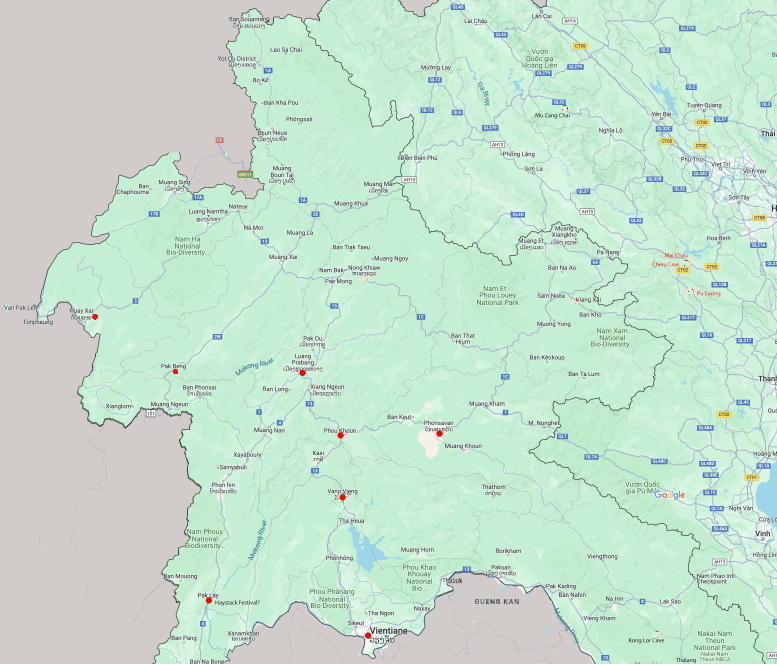
We stopped overnight in Pakbeng, where there were many hotels strung along the main road up the hill from the river, and a working ATM giving us much-required local currency (we forgot to do that at the border). Then it was onto a different long boat for the second day on the river. This was a better boat - more room and quite comfortable. We particularly appreciated being able to sit up on the bow, watching us shoot through the swirling water. Along the way there was very little in the way of wildlife to see. One elephant, some butterflies and dragonflies - not much else.
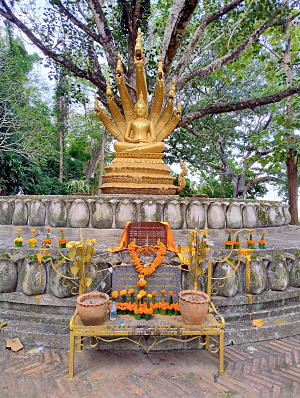
On arrival in Luang Prabang we were dumped unceremoniously in
the middle of town by the communal tuk-tuk from the river, but a quick
purchase of a local sim card put us back in touch with Mr Google, and we
followed the map to our hotel, in a quite pleasant part of town. Luang
Prabang is a rather nice place; lots of places to eat and drink,
including bars along the banks of the river. Our hotel was near
some major wats, all interesting to visit, and the monks came
directly past the front of the building on their morning food-gathering walk.
Kaye had been given some silk thread by a friend last year, and using it in her weaving made her eager to find more. There is a craft village outside of Luang Prabang, so we hired a tuk-tuk to take us out there and wait while we looked around. The first place we stopped at had exactly what Kaye wanted, but they wouldn’t sell her the thread, only the woven shawls. Across the road we found another weaving co-op where they were happy to sell the thread, so Kaye was able to buy several skeins of silk - our sort of souvenir.
We knew about the Plain of Jars in central Laos, so we caught a minivan to drive the 260 kilometres to Phonsavan - it took over eight hours. The road is atrocious, and it is astonishing that any of the vehicles last long enough to complete the journey. We hadn’t booked a hotel, so just picked one at random to tell the taxi driver where to take us. It was a huge, under-lit, gloomy place with almost no staff - certainly none when you wanted them. In fact, it was so under-staffed that when we left we saw no-one, and forgot to give them back the key to the room - we accidently took it to Vang Viene and had to send it back - and that was not as straight-forward as we assumed it would be.
The taxi driver asked us if we wanted him to drive us around the next day, so we agreed to use his services to visit the Plain of Jars and the old capital, which had been destroyed during the American (Vietnam) war. Our tour started off in town, with a history of how this area was bombed by the USA during the war - it was on the Ho Chi Min trail, and was the most bombed area of Laos. Now we knew all this stuff theoretically, and protested about it in Australia. But seeing the shells and cluster bombs and the map of where bombs were dropped, then driving out around Phonsavan brought it home in a way nothing in Australia could. It is estimated that it will take another hundred years to rid the land of the unexploded armaments scattered around the area.
 Mr Chu, our driver and guide, was great; very open about how Laos
and its government work, very knowledgeable about his town and the
jars. The purpose of the jars is still unknown - lots of speculation by
archaeologists, and they may have been made by different peoples at
different times, then used later on for a purpose not originally
intended - all rather mysterious. Some are over two metres tall. The sites
are pitted with bomb craters, and there are caves where people took
shelter during the war, only to be bombed in the caves. There were three separate sites with jars, and the third one was approached by walking through rice paddies. A bomb crater in the middle of the rice was being used to grow fish. We then drove along another terrible road to the old capital, Xiengkhuang, which was completely destroyed during the war, except for one
house and a buddha statue perched on a plinth, with just the columns from the building around it.
Mr Chu, our driver and guide, was great; very open about how Laos
and its government work, very knowledgeable about his town and the
jars. The purpose of the jars is still unknown - lots of speculation by
archaeologists, and they may have been made by different peoples at
different times, then used later on for a purpose not originally
intended - all rather mysterious. Some are over two metres tall. The sites
are pitted with bomb craters, and there are caves where people took
shelter during the war, only to be bombed in the caves. There were three separate sites with jars, and the third one was approached by walking through rice paddies. A bomb crater in the middle of the rice was being used to grow fish. We then drove along another terrible road to the old capital, Xiengkhuang, which was completely destroyed during the war, except for one
house and a buddha statue perched on a plinth, with just the columns from the building around it.
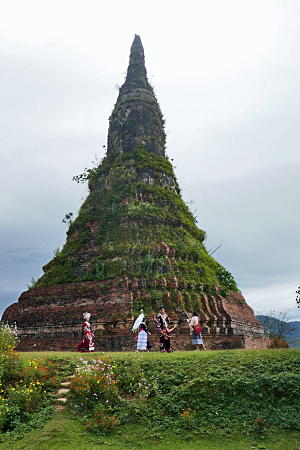
Before leaving the area around the old capital we went to That Foun, a stupa up on the hill overlooking Xiengkhuang. A group of Hmong people were on the site, taking their photos against the stupa, letting us also get a shot of them in vibrant costumes.
In the morning another very long and tortuous minivan drive took us to Vang Viene on the Nam Song river. This town hit the headlines just before we returned home as the Laos party town where six backpackers died from methanol poisoning. It is a lovely little town in a beautiful setting, attracting young backpackers looking for adventure tourism - hang-gliding, shooting the rapids, trekking in the hills. We stopped off there as a little break after the long drive from Phonsavan. We aren't adventure tourists, but we enjoyed walking along the river, watching the sun set reflecting off the water. While we were in Vang Viene we also arranged to get the hotel key sent back to Phonsavan. We had intended to post it, but agreed with the locals that it was better to get a minivan driver to take it there directly, so we left it with the hotel receptionist to sort it out, and trust that it happened.
 Then it was off to Vientiane on the 'high speed' train.
We had an apartment in the tallest building in the city; it made navigating
around easy - we just looked for our skyscraper and walked in that direction
to get home. We had a bit of organising to do; we needed air tickets to
Hanoi for the next leg of the trip, and we needed to plan where to go. We
hadn’t mapped out a thorough itinerary for Vietnam, so forward plans were vague. We managed to find a
good travel agent and sorted out the ticket, and we also put together a bit of a plan for
where to go once we got there. So now we had Vientiane to explore.
Then it was off to Vientiane on the 'high speed' train.
We had an apartment in the tallest building in the city; it made navigating
around easy - we just looked for our skyscraper and walked in that direction
to get home. We had a bit of organising to do; we needed air tickets to
Hanoi for the next leg of the trip, and we needed to plan where to go. We
hadn’t mapped out a thorough itinerary for Vietnam, so forward plans were vague. We managed to find a
good travel agent and sorted out the ticket, and we also put together a bit of a plan for
where to go once we got there. So now we had Vientiane to explore.
The city has lots of grandiose buildings, all associated with the government. There are quite
a few rather lovely temples, and the central city is flat and very walkable, so we covered a lot of
ground seeing what was there. There is a night market along the banks of the Mekong River; it was quite extensive, but not as vibrant as those in Thailand.
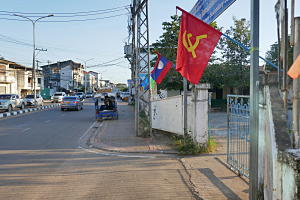
We noticed a lot of hammer and sickle flags decorating the buildings, but we saw no other overt signs of a socialist state.
We also went out to the Buddha Park, about twenty-five kilometres out of town. Sort-of interesting enough - a rather strange collection of concrete Buddhas in various states of repair.
Our apartment was very close to the local bus station, so it was an easy trip out to the very quiet airport to fly to Vietnam.
Choose the slideshow that you want to see from the selection button. You can display and choose individual pictures from the thumbnails or use the forward and back pointers to view the slideshow at your own pace.
|
|

| ||

|
|

|