|
|
|
|
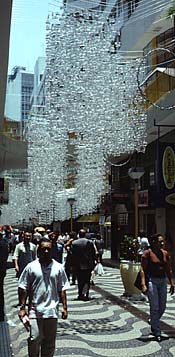
São Paulo is a city of some 19 million people, but no overtones of being a dangerous place to stay. We spent most of a week there, due in no small part to the Argentinean Consulate. Australians and New Zealanders need visas to enter Argentina. We had planned to travel across the north-east of Argentina to get from Brazil to Chile, then to re-enter Argentina in the south, for our return trip to Brazil. It was four days before the Consulate was open, then they would only give us a single-entry one month visa, and that took two days to issue, with much bureaucratic running around, including a demand for a letter from our Embassy - very time-consuming to arrange. The consul explained that we should have applied for our visas in Australia; they would have issued the 3-month reentry visas we wanted. This was cold comfort, and we rapidly changed our travel plans, deciding to avoid northern Argentina and go through Bolivia to Chile, saving our precious visas for the south.
My Portuguese was woefully inadequate, but we managed to make our way around the city, visiting the botanic gardens, Ibirapuera gardens, and making a side trip to the coast for a day. We walked a lot in São Paulo, but outside of the very centre the main thoroughfares are designed for cars, and we found ourselves trudging through the canyons of multi-level freeways, choking on the hot exhaust fumes.
|
|
|
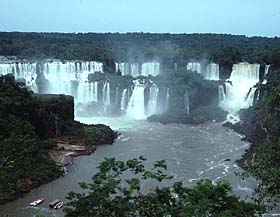
We went to Paraguay just because it was there and it seemed a shame not to visit. It was a relief for me to switch to Spanish, and to have some chance of being understood. Ciudad del Este, the border town across the river from Foz, is a free port, packed with shopping arcades and Brazilians over for the day on buying sprees. We bussed across the country to Asunción, situated on the Rio Paraguay. Paraguay boasts a thriving inland shipping service, and we tried to find a ship going north to Corumba, on the Brazil/Bolivian border, but the service was discontinued, so we back-tracked north-east to reenter Brazil at Pedro Juan Caballero. There was little to see in the Paraguay countryside, but the scattered Mennonite communities added interest, and the countryside just before the border was a climber's paradise, with hundreds of old volcanic necks erupting from the plains. We were also pleasantly surprised to see lots of rheas running wild in the farmland.
|
|
|
The border crossing at Corumba is annoyingly difficult; Brazil has no immigration office at the border, located some kilometres out of town. After accidentally crossing into Bolivia without completing Brazilian formalities, we scurried back into Corumba and spent three hot and exhausting hours being shuffled from one office to the next, finally finding the immigration office right back where we started, at the bus station. Paperwork completed, we crossed into Quijarro, the dusty Bolivian border town, and went straight to the railway station, hoping to get on the train to Santa Cruz that day. The train didn't leave until late afternoon, but the ticket office was closed for the day, and the only tickets on offer were from touts - dated yesterday, at twice the standard price.
Six-thirty the next morning saw us up and queuing at the ticket office, rumoured to open at seven. There were separate mens' and womens' queues stretching down the platform. Seven o'clock came and went with no sign of life at the office, but eventually the police controlling the lines forced us into neat crocodiles before handing out slips of paper - we needed a slip of paper and an ID card for each ticket bought. Even before the office opened the trade in slips of paper and ID cards was in full flight. As the morning dragged on the queue formed and reformed around us, but we stayed mysteriously near the end. When the ticket sales began, the trade in paper slips (ie. places in the queue) and IDs was joined by trade in purchased tickets, as most of the people in the queue had no desire to catch the train, they were buying for the touts - it was a total farce. Some three hours later I made it to the window and was able to get two seats on the 'pullman deluxe', an interesting name for a carriage that looked like a vandalized reject from the Indian railways!
The train departed that evening only three hours late, and some 20 hours later we chugged into Santa Cruz, after a trip that left us feeling more seasick than anything else. The carriage rolled and rocked on the badly-maintained lines, and the jolting was so extreme that we often bottomed-out on the springs.
Santa Cruz was just an overnight stop. We checked into the nearest hotel, and set out to explore the market just on dusk. Stalls clustered in profusion in the narrow, twisted streets, easy to get lost in - we promptly did just that, and spent quite some time working out how to get back to our hotel. It was only later in the night that we realized that hotels advertising saunas (as this one did) were really brothels. We spent a sleepless night ignoring the banging on the door and listening to the clacking of high heels on the steps and the endless unexplained furniture dragging that seems to characterize such places.
Since we were only in Bolivia in order to get to Chile, we hurried across the south of the country, taking a bus to Cochabamba, then on to Oruru the following day. The bus trip up the mountains was spectacular. It rained heavily as we ground our way up the winding mountain road, and into the clouds. Oncoming vehicles and massive rock faces loomed out of the swirling mist, but when the curtains of cloud parted we had wonderful views down into the steep valleys and through the verdant rainforest. Waterfalls cascaded down the sides of the mountains and poured off into the raging streams forming around us. As we slowly came up out of the cloud and onto the antiplano the view changed; the sun came out, the countryside flattened, and we drove through beautiful high alpine valleys, dotted with alpacas and widely-spaced farms. The sight of Jesus Christ on the hill, arms open wide, heralded our approach to Cochabamba.
|
|
|
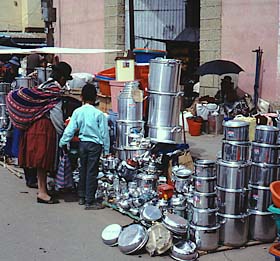
We spent a little longer in Oruru, hoping to link up with the train to Calama, in Chile. The train station wasn't deserted - there were queues of people at the office window - but there were no officials in sight, and the window was firmly locked. Notices posted on the window convinced us that the only possible train had left the previous night, and that we would have to wait four days before the next one. Oruru isn't a very exciting town, but it was pleasant enough to visit the many market streets, and we found eye-catching weavings to buy as souvenirs. We later met a couple of travelers who had taken the train, and discovered that it was far from the wonderful trip we had been led to believe it was. They told us it took 37 hours to get to Calama, at one stage taking five hours to go about ten kilometres. They also told us all about the behaviour of the smugglers, but they didn't even mention the scenery.
On the other hand, the bus trip from Oruru to Iquique in northern Chile is one of the most spectacular bus trips we have taken. Starting on the antiplano, we drove out through the desert, past little villages with beautiful caricature churches surrounded by sad-looking graveyards. High as we were (about 12,000 feet), the mountains surrounded us, distant and remote. Much of the route was through dramatic hilly country, past lakes with tiny pink dots of flamingos and snow-capped volcanoes. On the Chilean side of the border we drove past some of the most amazing country of all, with wind-blown sculptured rocks and sand forming pseudo cityscapes on both sides of the road. We would have loved to get out and walk around the area, but the bus thundered on.