|
|
|
|
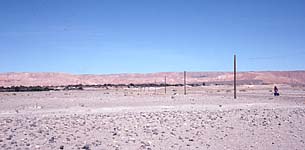
The free zone (zona franca) attracts lots of Chileans to Iquique, and the bus station was crowded with people carting huge parcels and bags, all of which had somehow to fit into the bus. Eventually we all crammed in, and set off across the desert for Calama. It was hot down by the coast, and didn't get much cooler when we headed in to the mountains. We detoured into Chuquicamata, Chile's major copper mine. It seemed a souless place, the dusty streets deserted, and the barracks-like public housing looking like something out of a concentration camp, numbers branded on each building.
It took longer to get to Calama than we had anticipated, and the bus company employee at the bus station echoed our thoughts by saying that there wouldn't be a bus to San Pedro so late in the day. We wandered off with little hope of finding transport, but blundered straight into another set of buses leaving immediately for the Argentinean border via San Pedro. "Quick! Run! Get a ticket on the bus!" and we were going to make it for Christmas. We arrived in the late dusk. San Pedro is very popular, catering to a wide spectrum of travelers and tourists, but we eventually found a reasonable if somewhat expensive backpackers place to stay. We celebrated Christmas with a great multi-course meal at a restaurant recommended by the hostel owners - it came complete with pisco sours and champagne, and was doubly welcome, since our regime of travel meant that we hadn't eaten a proper meal in the previous two days.
|
|
|
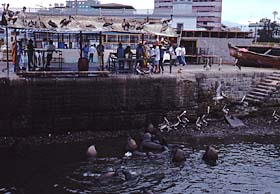
We were heading back to the coast - first to Calama, then on to Antofagasta, another port city. It is reminiscent of Iquique, crammed between hills and ocean, sea lions swimming in the harbour. The fish market attracted thousands of pelicans, vying with the sea lions for the scraps. Our hotel room was across the street from a loud disco, pumping music into the night until 4am. On the positive side, this gave us lots of time to sit in the window and appreciate the giant illuminated advertisments that ran across the entire massive hillside behind the town.
Antofagasta is the main port for shipping the copper produced at Chuquicamata. It has been a very rich place, and the wonderful architecture reflects a golden age, when copper barons erected their offices to show off their wealth. Even the poorer buildings were interesting, with many built from North American timbers shipped down in the returning vessels. The railway station is another architectural marvel, and the train still runs back and forth to the port laden with sheets of copper.
|
|
|
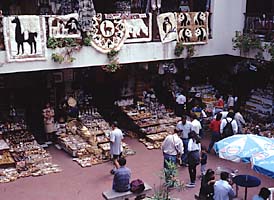
Another overnight bus, with the luxury of semi-cama (almost fully reclined), and we were in Santiago. We planned to stay in the new youth hostel, but they have a policy of separate dorms for males and females, useless to those of us who travel as couples, so we headed for the cheap hotel sector of the city and found a friendly modestly priced place to stay. It was New Year, exactly fourteen years since we had last been here, when Pinochet was in power, and the difference was astounding. Where once we had hardly seen a soul out on the streets at night, now the city was packed with people celebrating, fireworks were exploding, and it was a different place entirely. Some things were unchanged; Chez Henry and the many booths selling coffee and fast food still catered to the central city, the metro was still efficient, and the city still struck us as one of the more pleasant places for pedestrians.
Unfortunately Geoff was quite ill, and increasingly had to stay within the confines of the hotel. We couldn't really do anything until he recovered, and spent a few anxious days just hanging around. We had business to attend to - airline tickets to alter and a booking to make for the boat down south - and this took some time to sort out. Once Geoff was a bit better we managed a day trip out to Pomaire, a small village home to hundreds of potters. Some travelers we met in San Pedro had recommended it, saying that the pots were fantastic, but we found them uniformly mediocre, and very disappointing. Amazingly for me (Kaye) we didn't visit any of the wineries in the district, but I did sample quite a bit along the way and developed a liking for the Cousiño Macul blanc de noir.
Our booking on the boat to Puerto Natales determined the amount of time we had to get to Puerto Montt, our point of departure. We had trouble getting both the type of cabin and the departure date we wanted, and had settled for a more expensive cabin at a later date, giving us lots of time in central Chile. We decided to travel short distances and stop in more places. On one of our forays to the many bus stations in Santiago we had met Scott, the owner of a backpackers' hostel in the city. He generously furnished us with a photocopied sheet of recommended places to stay in southern Chile and Argentina, many of them family homes of the type we liked, and we looked forward to staying with some of the local people.
|
|
|
Talca looked like a possible stop in what was envisaged as a slow meander through central Chile, but it had nothing to hold us. Hmm. Another look at the map. How about Concepción? It was out on the coast on the Biobio river, with a very pleasant drive through rolling hills. The country immediately outside the city was vast flooded wetlands, but there were almost no birds to be seen - a puzzle, since it looked like ideal country for all manner of wildlife. Our bus stopped at the bus station, well out from the centre of town. We walked around the corner and saw a bus just about to pull out, bound for Temuco. A quick look at each other, and we were running for the bus.
Concepción? Been there, done that! We were off to the south.