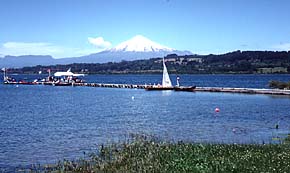
Temuco proved to be a place where we hunted in vain for things mentioned in our guide book. There was no sign that the hotel we selected had ever existed at the address shown; the indigenous women's co-op was nowhere to be seen; and to cap it off we couldn't even find the bus station we needed to leave from! One thing we could find in Temuco was the craft market. We were tempted to buy one of the gross 'Mapuche indian' dolls. They have amazing faces, with teeth more like beavers than people, and when you lift them up their shirts lift up and their little pricks rise to the occasion. We resisted the temptation.
|
|
|
|
We decided on a day trip to Pucón, rather than a stopover, and were very happy with that decision. Pucón is closer to the foot of the volcano, and is a base for adventure tours to the summit and for fly-fishing tours, but it is also very up-market (downright expensive!) and attracts lots of rich Chileans and Argentineans, complete with maids and nannies for the children. It also had one major drawback that didn't seem to infest Villarica - it teemed with huge, blood-sucking flies. Luckily they were slow-flying, but they resembled large horseflies, and were very difficult to discourage, making it impossible to stretch out on the beach in peace. These flies were to be found at every lakeside stop we made from then on, and are a seasonal pest. We were unable to find out anything about them, despite asking many people about how they breed and how come they were so closely associated with the lakes.
|
|
|
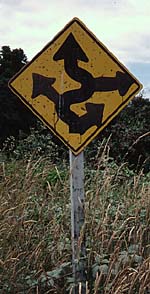
Coñaripe was on our route, but we timed our trip to give us a few hours there and continue on to Panguipulli on the same day. The village was very small, very quiet, and particularly plagued with horseflies. We walked along the deserted black sand lake beach, swatting left, right and centre to stop the bites. In desperation we left the lake and walked back out the road into the countryside, but the flies formed an entourage and followed us all the way. A switch of vegetation applied to the body like a penitent from the middle-ages was fairly effective, but we soon worked out that the flies used smell to locate us. They flew past anyone trailing in a group until they reached the leader, and concentrated all their venom on him/her. For the rest of the walk Geoff and I got slower and slower, each endeavouring to be the one trailing behind!
Panguipulli is decked with roses, growing on the road verges and median strips and planted in profusion in the many gardens; at that time of year they were in full flower, and made a great impression. The lake is quite a walk away from the centre of town, and provided a peaceful shady spot to relax and watch life go by.
|
|
|
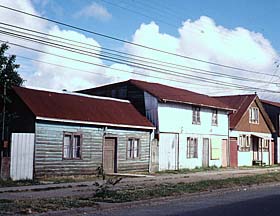
Further west, at the river mouth, is a series of 17th-century forts. We went to Niebla and Corral, across the river from each other. The forts are in quite good condition, with lots of canons facing out to sea to ward off invaders. Niebla (mist, fog) lived up to its name, and the clouds swirled in, shrouding the countryside in soft grey folds. We also went further up the coast to the fishing village of Los Molinos, where we watched the fishermen bring in catches of sea squirts, eating the choice bits raw, just rinsed off in the polluted harbour water.
We decided to have one last look at the lakes, and went out to Ensenada, on the far end of Lago Llanquihue. The bus was old and slow, and we drove along the lakeside past the occasional guest house or restaurant. Just as we were about to turn away from the lake I realized that this was Ensenada; there was no town, just a scattering of widely-spaced buildings. We hastily got off, and walked back towards the lake. The Lonely Planet had a recommendation, but we had no idea where it might be. A minor bit of roadworks merited two policmen as guards; they'd obviously been there some time, judging from the pile of dead flies at their feet. We stopped to ask directions. They looked at the name, laughed, and just said that it didn't exist anymore. The first alternative place we inquired at did have room, but the price was out of all proportion, so we kept walking back along the road and found the recommended hostel. The policemen were right; it had burnt down. However, there were a few chalets scattered around the property, and we were shown to one of them. Ensenada is about as down-beat a resort as you could get. There was no-one there. We ate alone in an expensive restaurant with pretensions, and the lack of people extended to our hosts. In the morning we couldn't find anyone at all, and eventually put the money for the chalet into an envelope, pushed it under the door, and left.
Puerto Montt was dismal and sodden under a grey downpour when we arrived. With no relief in sight, we stoically trudged up the hill to the Uribe family home, a wonderful place to stay. Perla welcomed us in and we were soon drying off in the warm kitchen. We spent a couple of days exploring the town and the port of Angelmó. There were penguins in the bay, endlessly fascinating for those of us unused to them. The opportunist pelicans flocked in the wake of the penguins, picking up the scraps and taking advantage of the turmoil they caused amongst the fish. Angelmó throngs with craft stalls and loads of little cafes offering seafood dishes. In between the town and the port huge mounds of wood chips await export to Japan.
|
|
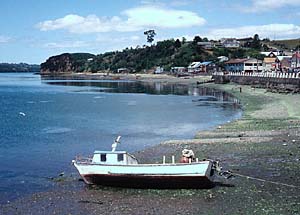
of the beach, with the blue roof |
We used Chonchi as a base, making a number of side trips. One day was spent at Cucao and the National Park, where we walked along the beach and through the forest. This part of Chile is the home of fuchsias, and they grow wild all over the place, alongside giant rhubarb-like plants with leaves up to a metres across. On another day we caught a taxi to the village of Castro, where we had stopped briefly on our way to Chonchi. We wanted to re-visit the church, which is an amazing salmon and violet gothic creation with the interior in wood and the exterior in wood and corrugated iron.
|
|
|
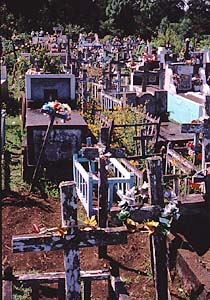
Some five kilometres from Chonchi a small ferry runs across to the island of Lemuy. There are few cars on the island, but a road weaves a path to the far end. We figured on walking about half way and turning around; a round trip of about 16 kilometres. The countryside was pleasant, without being very exciting, and there were lots of birds along the way. We stopped to look at the distinctive wooden church and to visit the flower and ribbon bedecked graveyard, as festive as a fairground. After a meager lunch at our chosen turning spot, we walked back over the same ground, and caught the ferry back to Chiloë. As I walked down the ramp I slipped and totally stuffed up my knee, doing in the ligaments. With no choice, I walked the five kilometres back to Esmeralda, but couldn't walk at all for the next three days, a sad end to what had been a great part of our trip.
Bung knee or not, the time had come to return to Puerto Montt. Waving a sad goodbye to fellow travelers who had become friends, we caught the bus back to the mainland.