|
|
|
|
We crossed the dreaded Golfo de Penas overnight. This is the one section of exposed waterway on the route, and if anyone is going to be seasick it will be here. Geoff and Peter took anti-seasickness tablets and went to bed early, both sleeping through the night without any trouble. I'm one of those superior bastards who have never been seasick in their lives, and just wished it was rougher.
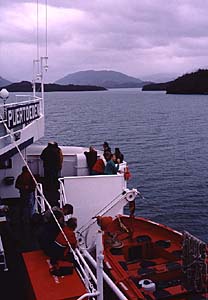
South of the Golfo de Penas the ship winds its way through some incredibly narrow passages, including the S-bend of the English Narrows, so tight we felt as though we could almost touch the sides. Navimag has a monopoly on this route, and in return the ship is obliged to stop at Puerto Eden, the only habitation in this fiordland wilderness. We anchored off the village and they motored out to meet us; some passengers were leaving, some were joining us, and other people came on board to set up an impromptu craft market on the vehicle deck.
Further south the weather closed in; there was fresh snow on the tops of the mountains, and the rain kept us inside or clustered under the few bits of shelter on the deck. Waterfalls plunged dramatically down the shiny black rocks as we neared the Angostura Kirke, one of the narrowest navigable routes in the Chilean waterways, and the gateway to Puerto Natales. Kirke can only be passed at the turn of the tide, and we would have to wait a few hours. Rather than heave to, the captain took us on a side trip to a nearby glacier, close enough to the ship to be visible through the misty rain, its ice field coming right down to the fiord. The sun broke through again, and we were all crowded onto the deck waiting to come into Puerto Natales. Fingers pointed and our imminent arrival was heralded by raised voices from excited passengers, but we kept steaming past! For three hours we patrolled up and down the fiord, just off the port, waiting for the blustering wind to drop. There are no tugs, and the captain had to carry out a slick bit of manoeuvering to bring the boat into the dock just using its own power and the winches.
|
|
|
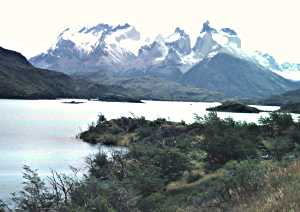
Our second tour was a day trip to Torres del Paine National Park. As such trips go it wasn't too bad. We drove out through the desert countryside, with our first stop at the milodon cave. This is really a huge overhang, created by the ocean when this part of the coast was much lower than it is today, and used as a shelter by our cave-man ancestors. The remains of a giant ground sloth were found here, and a fibreglass replica sits near the entrance. The trip continued out to the park, with occasional sightings of native hares, ñandu (lesser rhea) and even a zorro (native fox). At the park entrance there was a family of zorro begging food from the tourists, but the cubs were very shy.
|
|
|
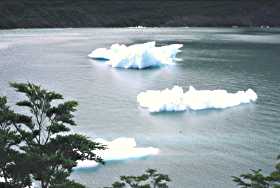
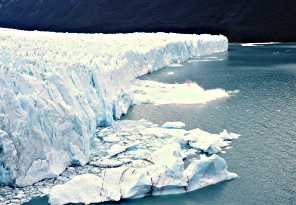
On our way out to Lago Grey we stopped to photograph one of the stunning lake views when a low rumble drew our eyes up to an avalanche enveloping the glacier with a flowing river of snow and ice. Lago Grey is quite stunning. The glacier forming the lake is about 12 kilometres up the far end of the lake, but the iceberg field congregates against a low pebbley causeway, where we could walk along the lake. I found a rock and sat back in the warm summer sun, sucking on little bits of twelve million year old ice (one estimate I heard), watching young army recruits out on a training run across the loose pebbles, jumping onto the icefloes as a show of bravado. We came back into Natales at sunset, past lakes shot with silver and gold, and fields of local wildflowers.
Our last port of call in Chile was Punta Arenas, on the western shore of the Straits of Magellan. The road from Natales was potholed and dusty, but nowhere as bad as other travelers had suggested. The town was surprisingly uninteresting, and nowhere near as scenic as Natales. We spent much of our time trying to find the best way to get to Tierra del Fuego, finally deciding to go by bus, since flying was too expensive. Our bus went north-west, to cross on the ferry at Puerto Espora, rather than Porvenir. While we waited on the beach dolphins played in the waves. During the crossing we spied a black and white shape cavorting in the wake of the boat, and everyone cried Orca!, but we later decided it was one of the pied dolphins that can be found in the area. The countryside in Tierra del Fuego differed dramatically between Chile and Argentina, with stark desert in Chile and wooded lands in Argentina; it must all have been wooded at one stage. The 'land of fire' lived up to its name, and gas flares burned at the scattered oil pumps.
|
|
|
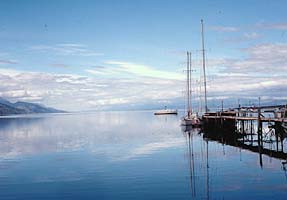
If we have any regrets about our trip it would be about the decision more or less forced on us to leave Ushuaia after only two nights. We were finding travel in the south fairly expensive (this was a common point of discussion with all the travelers), and we wanted to find the cheapest method of getting up to El Calafate. We weren't keen on backtracking by bus back as far as Natales, in Chile, and preferred flying, if possible. The Argentinean air force (LADE) had the best deal, cheaper than the bus and a lot cheaper than the commercial airlines, but it only flew twice a week. We had to decide whether to go the next day or the next week; we opted to go now. An interesting flight, hopping from town to town, with no guarantee that they would deliver us to El Calafate, since the route was dictated by weather.
The plane landed on schedule at El Calafate, but the airstrip is a long way out of town. While we were wondering how to get there one of the local lodge owners stopped and offered us a lift, although we had already told her we wanted to stay with one of her opposition. We treated ourselves to a chalet for a couple of nights, but this was the last time we would do that. We had been warned that Argentina was expensive, but nothing had prepared us for the major assault on our budget that travel in southern Argentina would make, and we soon learned to look for the cheapest alternative going.
|
|
|
A four hour bus trip from El Calafate brought us to the settlement of El Chaltén. Founded in 1985, it is the newest village in Argentina, and is strategically placed close to the Chilean border. The town is strung out along a very pretty valley, and provides excellent walking in the Glaciers National Park. My knee had improved to the point where I could go on day walks. We started with a gentle excursion along the river Las Vueltas to the cascades. These aren't on the river but on one of the streams flowing into it from the mountains, and were quite pretty, worth going out to.
|
|
in theNothofagus forest |
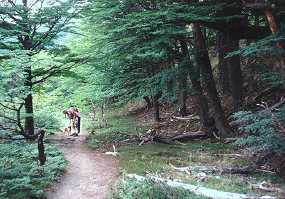
Our last trip was to Laguna de los Tres, an eight hour round trip. Again, the start of the trail was steep, but it later flattened out to an easy stroll. Along the way we first heard, then saw, patagonian woodpeckers tapping on the trees, and we came upon a group of bright yellow flowers shaped like tiny baskets. Just before the lake the trail gets extremely steep. Geoff went on, but I decided not risk my knee, and sat under a tree with another woman who had a sore ankle. She was from Rome, and didn't speak English. My Spanish doesn't run to social chat, so we ended up speaking in French, a truly international meeting. It took Geoff quite some time to get to the lake, but he came back saying that it was yet another spectacular view, and worth the climb. We had time on the return trip to call into Laguna Capri, a beautiful clear lake reflecting the mountains.
We had no doubt that the best bit of southern South America was definitely the far south - the glacier country and Tierra del Fuego. The region is breathtakingly beautiful, the glaciers are spectacular and are all different and special, and the surrounding countryside and forests is just wonderful. Unfortunately, the time had come to leave the mountains and start the last leg of our circle, going north along the coast of Argentina and back to Brazil. As with lots of journeys, things weren't that easy. To go north we had to first go south, so it was back to Calafate, then south-east to Rio Gallegos on the early morning bus. Ho hum.